.png?width=2167&height=417&name=Greenrock-Logo%20(1).png "Greenrock-Logo")

Share this
by Kevin Malone on Apr 16, 2026

Learn From The Masters
Whenever you are trying to make a sensible decision in a confusing or difficult time, it is wise to see what the smart people are saying and doing and to consider what history tells us. If we learn from the masters and from good long-term data, we usually come out on top. Today, we have examples of what long-term data and a very smart investor are telling us.
The Data
We will start with valuation data. We have used the price to sales ratio of the market historically to determine if the market is fairly priced, undervalued or overvalued. Alone, valuation can be a guide, actually an important guide. But what valuation cannot be is an automatic trigger for taking action to buy or sell. The history of investing in stocks is that prices stay undervalued or overvalued much longer than we can anticipate, and markets get overvalued or undervalued in ways that we cannot anticipate.
That said, valuation is critical to understand. It can give us a view of whether the wind is at our back or the wind is in our face. So, let’s look at the valuation of the domestic stock market today. Should we be optimistic or cautious?
The valuation measure we use is price to sales. Before we get to the current numbers, let us explain why we have chosen price to sales and not price to earnings. The short answer to this is that sales can be manipulated, but not as easily as earnings. You may recall the decade of the 1990s when companies were being rewarded with a rise in their stock price if they were producing consistent growth year after year. The institutional investors loved consistent growth, and by moving expenses from one year to the next, companies achieved that consistency. Until they could not do that any longer! And when that occurred, those stocks were sold by institutions and declined dramatically.
It is true one can do some manipulation with sales, but not as much or as efficiently as earnings. In addition, we have over 150 years of price to sales data, and it allows us to view market valuation over an extremely long period of time. The price to earnings data that is available is not nearly as long.
Today, the price to sales ratio of domestic stocks is 3.17. Alone, that may not mean much to an observer, so let us put that in perspective. The first time in history when the price to sales ratio of domestic large cap stocks went over 3.0 was the last quarter of 2024. None of the great bull market runs in the last 150 years had ever gotten to that valuation. That trend continued all through 2025 and the first quarter of 2026.
So, our conclusion is that stocks are ridiculously overvalued today, and ridiculous valuations have never been, nor will they ever be, a rewarding experience for investors.
What Are The Experts Doing?
You can find investors you trust in any market who have different views. For the purposes of this discussion, we will use the opinions of the person who is generally and universally thought to be one of, if not the, best investors of all time, Warren Buffett. Now, like any list of the best of all time, there can be various opinions. We choose Warren not because we would suggest he was the best of all time, but rather because we believe he would be on everyone’s list of the ten best of all time. In addition, we believe he was a thoughtful investor who took a long-term view.
Today, Berkshire Hathaway has between 50% and 55% of its portfolio in cash. This is the highest cash level he has ever had. In addition, the cash flow from his investments is very high. When he was recently asked what stocks were on his buy list, he said there were no stocks on his buy list. As he has often stated, when stocks are overvalued like they are today, patience and cash represent the quality and investment that will allow you to get great future returns.
So How Do We Invest?
The short answer is to proceed cautiously and be more concerned with protecting the downside than looking for high returns. We see two issues getting in the way of good returns. The first is valuation, as we discussed above, and the second is the level and future level of interest rates. Today, the yield on the 10-year U.S. Treasury bond is 4.3%. Now you can make predictions on the future of inflation over the next year or 10 years. We would say 10 years is very hard to predict, and while there should be some margin of error in your 1-year prediction, a 1-year prediction is a reasonable question to raise. Our view on that topic is that it is very hard to imagine the yield on the 10-year going down. Overvaluation of stock prices and a view on future inflation would suggest higher rates, not lower rates. So, bonds, to us, looks like they have risks similar to those of stocks.
Great, We Cannot Buy Stocks or Bonds!
True, you cannot buy bonds, but we have a substitute for bonds with identical volatility and downside protection that has gotten better returns with equal volatility. And, no, you cannot buy index portfolios, but you can buy stocks with high dividends whose dividends grow. So, let’s look at both of these ideas.
Bond Substitute
We have been working with a firm who manages diversified ETF portfolios which have, for over 25 years, produced for our clients results greater than those of the 10-year U.S. Treasury with identical volatility and better downside protection. The chart below shows the comparison of these two portfolios over time.
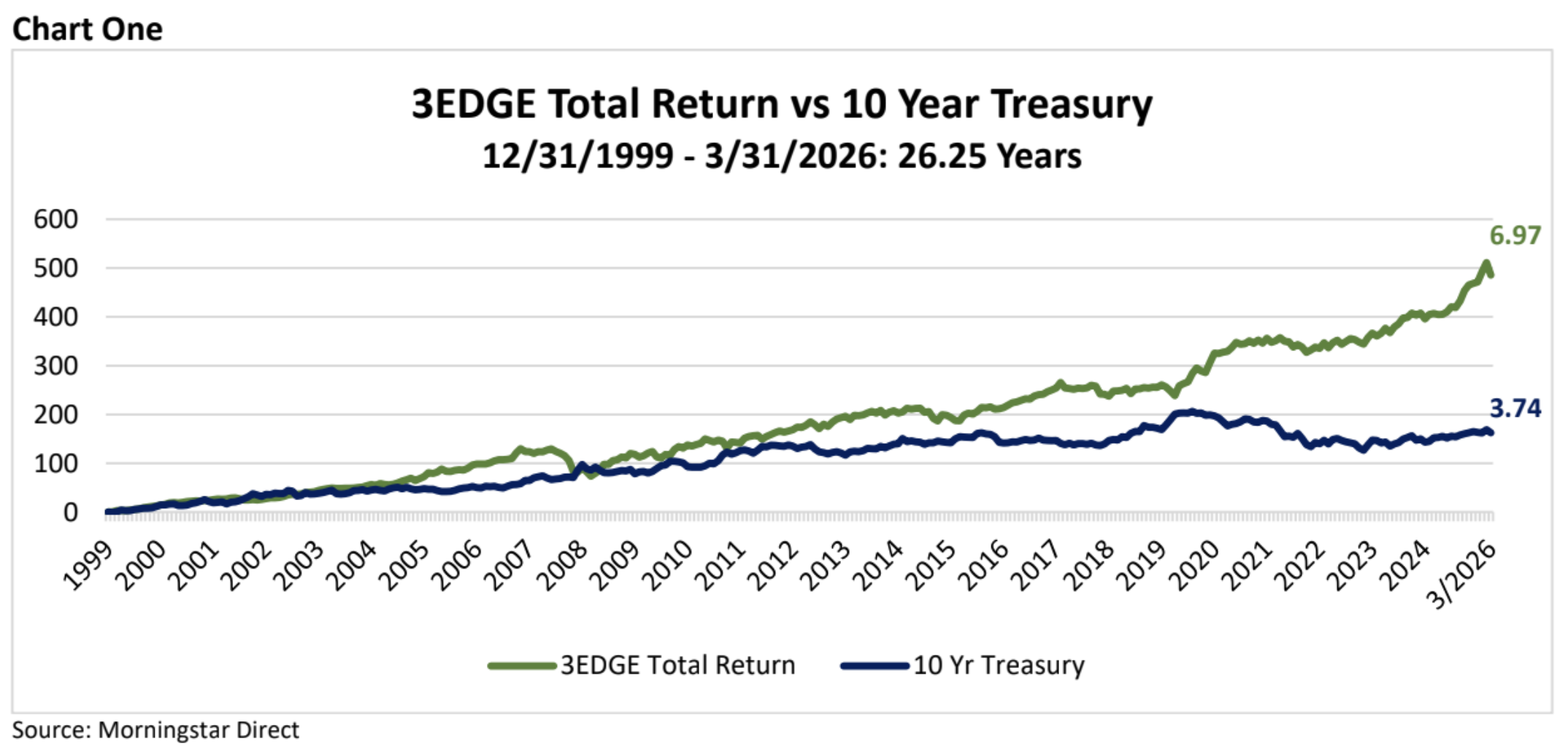
The interesting part of this idea, to us, is the certainty that we will be right. There are three possibilities of what happens to rates and, specifically, the yield on the 10-year. Rates can rise, fall or stay the same. If rates rise, your bond returns will be lower than the coupon and possibly negative, a bad outcome. History tells us that when happens, we get better returns. If rates fall, the total return of bonds will improve. History tells us sometimes we do better and sometimes bonds are a better idea, a mixed bag. If rates stay the same, your return will be 4.3%. History tells us we will do slightly better.
So, we like our position. Over the past 5 years, ending 3/31/2026, the return on the 10-year has been -1.04% while our returns have been 6.42%.
We also see the likelihood of higher rates in the future because of inflation.
Equities
The equity strategy we use has not only outperformed the S&P 500 since inception in 1957, it has outperformed the S&P 500 in 4 of the 6 calendar decades since then as well. The portfolio is a high and rising dividend portfolio. We have a domestic large cap, domestic small cap and international portfolio. The current yields on those portfolios are as follows.
Domestic Large Cap: 3.2%
Domestic Small Cap: 5.2%
International: 3.0%
We have written a paper on how and why this strategy both outperforms the index over the long-term, offers more consistency, and perhaps most importantly, gets attractive future returns when valuations are high.
The best historical perspective on why this is the only domestic core strategy we would recommend is the decade of the 2000s. During that decade, the return of the S&P 500 was -0.95% while our dividend portfolio achieved a return of 7.74%. This is exactly what we see over the next period. Will it be a decade? No one can answer that, but we think what we mentioned about Warren Buffett above suggests this timing is perfect for this strategy.
Other Ideas to Round Out Portfolios
We have two other areas we think make sense today, and they are private investments with cash flow and Bitcoin.
Private investments are generally thought of as higher risk investments, but there are other private investments that have cash flow. These are the private investments we recommend. We have four investments in different sectors and geography that have current cash flow of 5% to slightly over 6%. These have maturities in the 3-4 year range and have historical and expected total returns in mid to high teens. In addition, we have negotiated very low minimums for these investments. In all cases, the minimum is $50,000, but for some, the minimum is $25,000.
Bitcoin is a controversial subject with many investors. It is also a very volatile investment. That said, our research suggests that for long term investors, a small position in Bitcoin makes a lot of sense. We started recommending Bitcoin when the price was $6,000 to $10,000, and today, a Bitcoin trades around $70,000. We believe that the 7-10 fold increase will happen again from these levels. We have a short paper on Bitcoin that you may want to review. The case for Bitcoin is very simple, it is a replacement for gold and has many characteristics gold does not have. It is also a substitute for any currency one believes will be a stable investment over time.