.png?width=2167&height=417&name=Greenrock-Logo%20(1).png "Greenrock-Logo")

Share this
by Kevin Malone on Oct 14, 2026

The Name is not the Answer
In the 1970s, a fish wholesaler couldn't sell the Patagonian toothfish, so he renamed it "Chilean sea bass." It wasn't a bass, and much of it wasn't caught near Chile. Within a couple of decades, it was on fine-dining menus at premium prices, and it was overfished nearly to collapse. The fish never changed. The name changed what people would pay.
Fixed income has long been thought to be an essential part of investment portfolios. The name is brilliant as the coupon is fixed but the price isn’t, and neither is what the coupon buys after inflation. The name implies stability, and therefore investors plugged bonds in as a substitute for low volatility investments. Investors pay a premium for the word “fixed” and are now left with an asset class that is broken. Rates rose dramatically again in the third quarter, with the 10 Year U.S.Treasury Index losing -5.2% over those three months.
We took clients out of fixed income when the yield on the 10 Year reached 2%, February 2021. Our reasoning was simple, we did not see how a 2% return over the next decade could solve the investment return needs of any clients. In order to make that move, we needed a strategy that had similar volatility to bonds and a similar low correlation to equities. 3EDGE is a firm we have used for 25 years, and their Conservative strategy was the perfect solution for the time. Over the period when we sold bonds and put client assets in the Conservative portfolio, we have achieved an annualized return of 5.2% while an investment in the 10 Year actually saw a loss (-2.8%).
So, it is fair to ask whether this period of outperformance by the Conservative portfolio will continue and might we see the 10 Year outperform. As you know, we study what the smartest minds in investments are saying. Bill Gross was one of founders of PIMCO and he is thought to be one of if not the best minds in fixed income. Today he cautions on investing in fixed income with maturities longer than one year. We think he is right. Fixed income has been a broken asset for 13 years and rates are more likely to rise than decline going forward. If you are still in fixed income, now is the time to reevaluate.
The Domestic Stock Market Today
Future returns are easiest to earn when stocks start out cheap. In 1982, the S&P 500 traded at 11 times earnings, and an 18-year bull market began. By 1999, stocks had gone from very cheap to very expensive. The market peaked at the end of the first quarter of 2000, then fell almost 40% over 2000, 2001 and 2002.
That doesn't mean expensive stocks can't get more expensive. Many intelligent investors thought stocks were overpriced in 1997, then watched the index rise 55.6% over the next two years, with most of the gain coming from six stocks. Investors were right that the internet and the cell phone would change our world, and those technologies did change it for the better. Where investors went wrong was the price they paid for that change in 1999 and Q1 2000.
We have seen this pattern before. The railroad took travel from 4 miles an hour by horse and buggy to 40 miles an hour, and it cut the trip from Chicago to Denver from 20 days to one. But railroad investors earned reasonable returns only if they bought before the tracks were laid. By the time trains were carrying passengers, the stocks were too expensive. Internet and cell-phone stocks repeated the pattern. Of the companies that led the 1990s, only one was positive in the 2000s, and it took more than nine years to get back to even.
Why This Matters Today
AI will change our world for the better. One manager we work with was asked by his boss whether he needed more staff. He said that without AI he would have needed two more people. AI now organizes and drafts his communications to clients and prospects, and he only proofreads. Today's tools may look elementary two or three years from now.
But many AI companies are trading at very high prices. As you can see from some of the outliers on the chart below, they now make up an unusually large share of the index and are trading at high price to sales multiples. This is exactly what happened in 1999 with the internet and cell phone stocks.
We can't predict which ones will win. What concerns us is that many trade at valuations that could make the 2000s look mild by comparison. The chart below shows the valuations of the stocks that concern us most.
Chart 1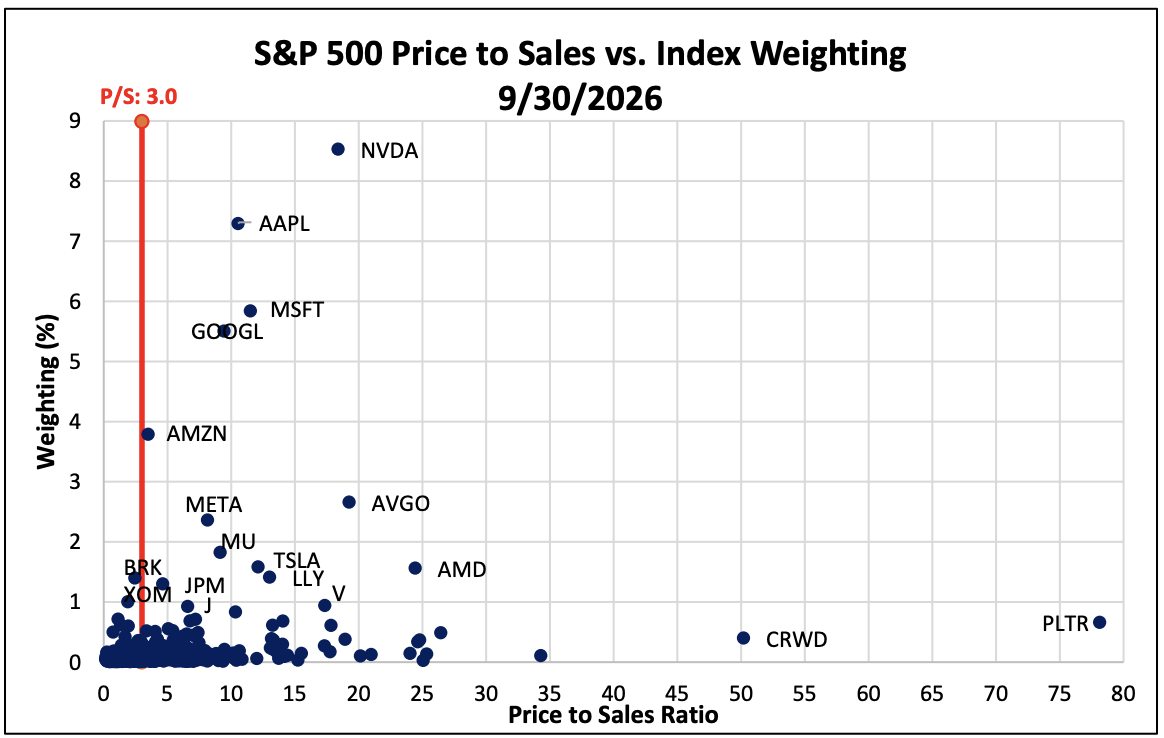
Source: Morningstar Direct
These are great companies, and that has never been the problem. Investors in 1999 weren't chasing bad businesses, and neither are investors today. The problem is price. A stock's future return depends on two things: how much the business grows, and how much you paid for that growth. When the price already assumes years of flawless growth, even a company that delivers can leave its shareholders with poor returns. This happened to the internet leaders after 2000. The question today isn't whether AI is real. It's how much of AI's future is already built into these prices.
What Is Reasonably Priced?
The answer will come as no surprise to our clients: good companies at reasonable multiples. Our domestic large cap high and rising dividend portfolio yields 3.4%, and our international high and rising dividend portfolio yields 3.0%. Over the last five years, the domestic portfolio has trailed its index while the international portfolio has beaten its index. Combined, they have slightly outperformed the global index. That is typical. Growing dividend stocks are boring investments in mundane companies. They usually don't rise as much as growth stocks, and they don't fall as much either.
Over full decades, that consistency adds up. Since the S&P 500 began in 1957, dividend strategies have outperformed it, and with steadier returns:
Returns by Decade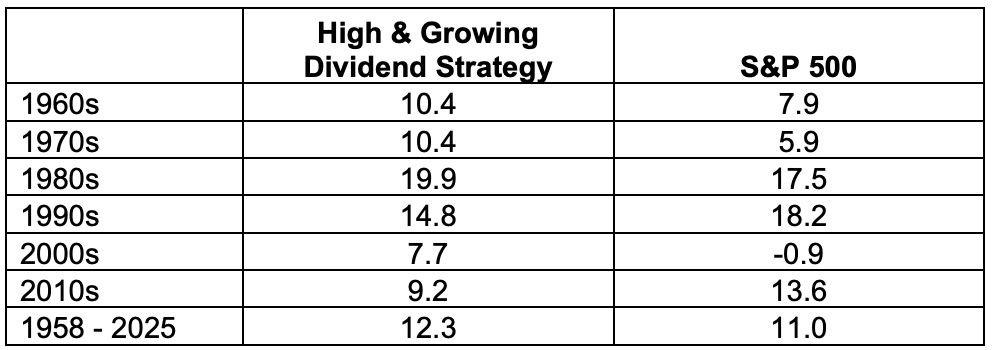
Source: Siegel, Jeremy, Future for Investors (2005), With Updates to 2025 and Morningstar Direct
The index fell short of 10% in three of six decades, and in the 1970s and 2000s it left investors with failing returns. The dividend strategy's worst decade was 7.7%.
Earlier this year, I spoke with the head of an RIA managing more than $1 billion. He said his firm uses index funds because when portfolios lose money, no one can criticize them. They simply tell clients everything went down. We think that logic fails clients precisely when markets are this expensive.
Today looks to us like the start of the 2000s, when the S&P 500 compounded at –0.9% a year and our dividend strategies compounded at 7.7%. Our portfolios more than doubled that decade while the index lost about 9%. No one can know exactly what the next ten years hold, but history shows that indexing into an expensive market has failed investors before. We like our position.
So, Domestic Equities and Fixed Income are Overpriced, How do we Invest?
The combination of our growing dividend strategy and the 3EDGE Conservative portfolio is our solution. We expect both to provide reasonable returns that will solve the investment return needs of your clients.
What Else Should We Use?
Private investments and Bitcoin should be part of your portfolios for very different reasons. We have recommended private investment to clients for 25 years. The percent invested in private investments differs client to client, but even conservative clients can benefit from some allocation. All of our private investments have positive cashflow, most from the time of the initial investment, and all have expected maturities of 4 years or less. Now it is worth saying those maturities can be and some have been extended, but we have never seen any of our investments extended by longer than one year.
Bitcoin is an investment that should be made with a very long time horizon. We say this because the value of Bitcoin will be realized over time, but it has been and will continue to be very volatile. We first recommended Bitcoin when it was in the $6,000 to $10,000 range. It then went to $70,000, fell to $15,000 and is trading around $85,000 today. Historically, Bitcoin has had periods of substantial rises, like it did when it went from $10,000 and substantial declines like it did when it went from $70,000 to $15,000. You should expect similar volatility going forward, but you should also expect similar longterm gains.
Bitcoin should be a small investment for clients with a long-term time horizon. Many analysts refer to the trading cycle of Bitcoin as the seasons of the year, it goes up in summer and down in winter. Today we are in the summer of Bitcoin. What does that mean about price? We would say no one knows, although you can find analysts with theories about how it will reach some higher number in the future. Our view is that while we like rises more than losses, predicting values is not productive. If your time horizon is longer than the next winter or bear market, then this rise, while nice to see, is not your goal.